

_<->1708724263995_9Y10OskXA8FdggLg.jpeg)
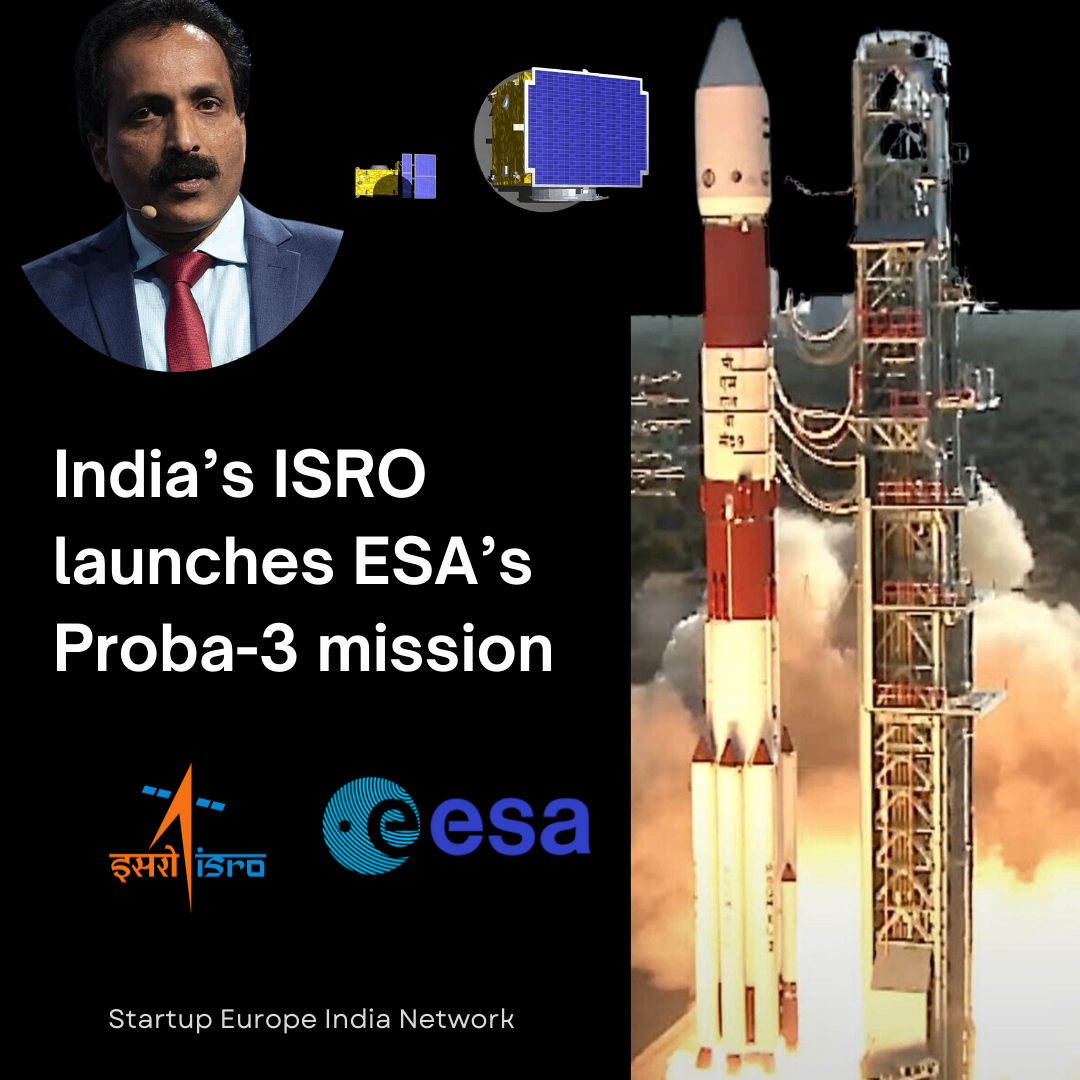
In a groundbreaking collaboration, the Indian Space Research Organisation (ISRO) and the European Space Agency (ESA) have joined forces to unveil the mysteries of our Sun. The successful launch of the Proba-3 mission on December 5, 2024, marks a new era in solar research and space exploration.
A Dance of Satellites
Picture this: two satellites pirouetting in space, maintaining a precise distance of 150 meters between them. This isn't science fiction, but the reality of the Proba-3 mission. The larger Coronagraph Satellite, weighing in at 340 kg, acts as the observer, while its 200 kg partner, the Occulter Satellite, plays the role of a cosmic umbrella, blocking the Sun's blinding disk.
This celestial ballet allows scientists to create artificial solar eclipses on demand, providing unprecedented views of the Sun's elusive corona. It's like having a front-row seat to nature's most spectacular show, not just once in a lifetime, but for hours on end, multiple times a year.
Unraveling Solar Mysteries
The Sun's corona, a realm of extreme temperatures reaching up to 2 million degrees Fahrenheit, has long puzzled scientists. How can the Sun's atmosphere be hotter than its surface? Proba-3 aims to shed light on this cosmic conundrum.
With up to six hours of continuous observation time, equivalent to witnessing about 50 natural solar eclipses annually, researchers will gain unprecedented insights into solar phenomena. This wealth of data promises to revolutionize our understanding of space weather, potentially improving predictions of solar events that can impact our technology-dependent lives on Earth.
A Technological Marvel
Proba-3 is not just about solar science; it's a testament to human ingenuity. The mission showcases cutting-edge formation flying technology, with the two satellites maintaining their positions with millimeter-level precision. This feat of engineering opens doors to future missions that could use multiple spacecraft working in harmony to achieve what was once thought impossible.
The mission's suite of instruments reads like a wish list for solar physicists. The ASPIICS Coronagraph, with its 1.4-meter occulting disk, allows for closer inspection of the corona than ever before. Meanwhile, the DARA radiometer measures the Sun's total energy output, and the 3DEES spectrometer studies electron fluxes in Earth's radiation belts.
Global Collaboration at Its Finest
The Proba-3 mission is a shining example of international cooperation in space exploration. Scientists from across Europe, including Spain, Belgium, Poland, Italy, and Switzerland, have pooled their expertise to make this mission a reality. With over 40 companies from 14 ESA member states contributing to its development, Proba-3 truly embodies the spirit of global scientific collaboration.
ISRO's Rising Star
For India, the successful launch of Proba-3 aboard its trusted Polar Satellite Launch Vehicle (PSLV) is more than just another feather in its cap. It's a clear signal to the world that ISRO is a force to be reckoned with in the global space arena. The PSLV-XL variant, which placed the satellites into their highly elliptical orbit ranging from 600 to 60,530 km, demonstrates India's growing capabilities as a reliable launch provider for complex international missions.
A Bright Future for Solar Research
As Proba-3 begins its journey to unlock the secrets of our nearest star, it complements India's own solar observation initiative, Aditya-L1, launched in 2023. Together, these missions promise to usher in a golden age of solar research, enhancing our understanding of the Sun's influence on our planet and the entire solar system.
The successful launch of Proba-3 is not just a triumph for ISRO and ESA; it's a victory for science and human curiosity. As we peer into the Sun's fiery corona, we're not just observing a distant star – we're gazing into the very forces that shape our cosmic neighborhood and, ultimately, our lives on Earth.
0
1

Comments